
What is “doing” healing?

I have talked about my healing process from coming out of the K-12 education system with my kids, who are ND and have invisible disabilities, on my other website P.A.T.H. I have titled these two blogs Life After K-12 and Life After K-12 – 6 months later.

In these blogs, I talk about “doing” healing. It’s an activity. An action. Healing doesn’t just happen over time. It’s something you have to be determined to do, face and work at it.

So what did I do? And what do I do to maintain myself in systemic work?

These are all going to sound small and insignificant, but it’s the consistency and doing these things whether you are in the mood or not. A lot of these items are a privilege to be able to do and access. It’s not an all-or-nothing; this is a prescriptive list that you need to all of it or don’t even bother. Little bits of everything consistently over time will build. Whatever speaks to you.

  • Be out in nature. It’s grounding, and the science behind our contact with nature and our mental health is solid. It will encourage reflection and feelings of peace.
  • Counselling. I am lucky that I get free counselling due to the nature of my work. I take full advantage of access to that and appreciate my counsellor very much.
  • Regulate my nervous system. Look up box breathing, meditation with guided YouTube videos, tapping, butterfly taps, stretching & movement, massage/touch/physical closeness to another person, and exercise. Research nervous system regulation activities. Intense emotions come up; launch into nervous system regulation activities immediately. Movement allows the emotion to flow through you. Emotions are like weather. We name it to tame it and watch them pass by.
  • Write and journal. Everyday. Get it out of you.
  • Gratitude List. As part of my journaling, I write things that I am grateful for. I particularly look for the little things I am grateful for amongst the challenging situation I was in.
  • Read. I read books about healing. Poems. Read about human resiliency and bibliographies.
  • Learn. I have been learning a lot about neuroplasticity and how malleable our brains are. How much influence we have in deciding to change our brains.
  • Be selective about your social media. There are some very helpful people offering great information on our brains and psychological health. I recommend the Pocket Psychologist.
  • Rest. I don’t overschedule myself. I need a lot of down time/alone time. I make sure I get it. Having healthy sleep hygiene. As I was healing, I noticed I was getting a lot more energy, and I was sleeping better at night.
  • Processing with a friend who gets it. I have friends who totally get this world and understand healing.
  • Mentor. Find people who are optimistic and who know or have skills that you would like to learn from.
  • Activity. Find an outlet. Helping people can be incredibly healing. Action. Either volunteer in the area that created the challenge to create change, or create your own volunteer activity.
  • Naturalpath. I started seeing a naturopathic doctor to optimize my physical health. The act of simply taking vitamins every day reminds me of self-love and intentionally taking care of myself.

Apply. Rinse. Repeat.

This is what has worked for me.
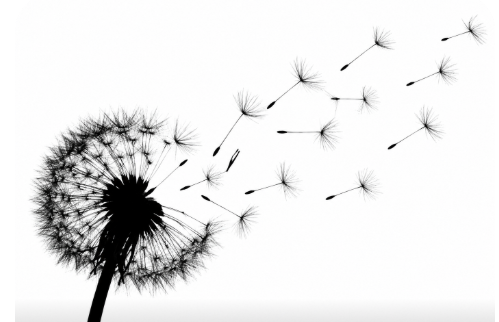
Planting Seeds

ID: Black and white image of a fluffy dandelion with some of the seeds flying into the air

Systemic Advocacy is all about planting seeds.

This is my visual when I think of what I am trying to do. I put something out there, wish it well, and off my seeds go.

Where they land and if they germinate into something else, I will never know the full extent.

We get meaningful feedback that recharges our batteries from time to time. But we will never have every single person write us an impact statement. The good or the bad. If you are experienced in systemic advocacy, you are well aware that you often wonder what kind of an impact you are making.

There are a lot of things that people do that no one is aware of. You don’t always have a witness to your important conversations, your insights and next steps, the pivots, allllll of the ka-billion little puzzle pieces that you assemble with people spread out.

I know a lot of people who do systemic advocacy, and they all have their hands in numerous little pots. They have all of these connections, and they have access to these pots because of the years of doing this work. They have built up this web of connections over time. The building of relationships expands your access. You get invited in more often; you get voted in. Through relationships, people listen to you. You get to listen to other people. They feel safe with you, so they open up and talk.

I am in a parents’ Facebook group, and I will always remember the night I went and posted that I was taking my human rights complaint to a hearing. I had mixed responses. Some people cheered me on. Others tried to discourage me. (I think it was well-intended, and they wanted to save me the impending discomfort.) But I will always remember this one person’s comment. They gave me this quote:

“If you think you are too small to make a difference, try sleeping with a mosquito.” – Dalai Lama from an African proverb.

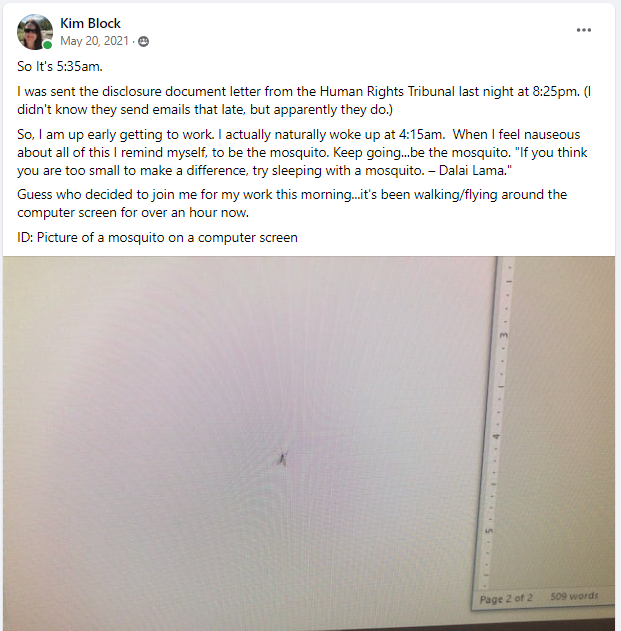
The next morning I set my alarm for 6 am to start working on hearing preparation. I had a mosquito that sat on my screen for an hour. Buzzing around and then landing somewhere else on my screen. That quote helped carry me through. Just be the mosquito, Kim, you can keep buzzing.

Facebook post: May 20, 2121

"So It's 5:35am. I was sent the disclosure document letter from the Human Rights Tribunal last night at 8:25 pm. (I didn't know they send emails that late, but apparently they do). So, I am up early getting to work. I actually naturally woke up at 4:15 am. When I feel nauseous about all of this I remind myself, to be the mostquito. Keep going...be the mosquito. "If you think you are too small to make a difference, try sleeping with a mosquito. - Dalai Lama" Guess who decided to join me for my work this morning...it's been walking/flying around the computer screen for over an hour now. ID: Picture ofa mosquito on a computer screen.

Thank you to all of the people who have blown their seeds into the wind, never really knowing the impact. The mosquito seed from a parent cheering me on was 5 years ago. Do they know what this has all blossomed into?

My university professor that encouraged me to not drop out. She has no idea what I am up to now.

Grateful for all of the people who have shared their seeds with me, and I hope to pass along my own, knowing full well I have no idea where they are going and to the full extent they will grow.

For the people who do give me feedback, I so appreciate it. It encourages me to keep going. I must be on the right track.

Embracing Grief

Anger is for things we can change. Grief is for things we cannot.

Anger has been my fuel. It has propelled me forward. I felt I was doing something. The action kept my sanity.

I really didn’t feel like I was choosing to advocate on a systemic level. That type of advocacy chose me. I unknowingly had my ankle tethered to a long rope attached to a bull. The school district smacked the bull, and that bull took off.

Anger, when funnelled well, can be a beautiful emotion. Filled with love. We can run on anger. Do things we never imagined.

For me, as I advocate and navigate all different kinds of systems, I still find myself grieving. Every now and then, it sneaks up on me when I am not prepared. Why am I sad all of a sudden?

To process the reality of systems. What they are, and what they are not. Grief is about acceptance. The non-death loss.

Embracing times to grieve and acknowledging the sadness has been really beneficial for my mental health.

Naming emotions and being aware of them, I believe, will assist you in your advocacy. The more self-aware you are, the more you can regulate and know when you need breaks. You can catch yourself before you start to dip.

Crying is so beneficial for our brains. It triggers our parasympathetic nervous system and helps our body to lower our emotional distress. It’s soothing and releases feel-good chemicals.

Sometimes we need to take a moment and embrace the grief. It really is sad that the _______________ system does _______________. It is sad that all these people are stuck navigating it.

I may not change things today by 2 o’clock, but I am not helpless. I can do what I can in my corner of the world. I can help other people.

Grief, like weather, comes and goes.

However, my actions are consistent. I am optimistic; all I can do is try.

Under the Microscope

Systemic change is not meant to be examined under a microscope. It is intended to be viewed through the zoom-out lens.

Don’t examine the ant that is part of the anthill. Be the hawk flying above that is spending years surveying the changing landscape.

If you want to see if the needle has moved, the smallest time period I would recommend would be a 10-year comparison period.

And really the best view would be 40-50 years.

What has changed in the last 40 years?

Are we getting somewhere?

What issues have changed? Which ones are persistent and have remained?

If you are going to judge your systemic advocacy progress on the last 6 months of your work, you will absolutely frustrate yourself. You will feel like you have gotten nowhere. Which will not necessarily be true.

Systemic work is about seed planting. Things grow over time.

Creating a new normal that society just accepts. Raising the bar. Changing expectations.

Micro level advocacy progress: you can see the steps. You can see the incline or decline.

Macro level advocacy progress: the steps are invisible. They are forever moving and floating around, changing levels and going up and down. Constantly taking steps forward, one step back.

Save yourself the mental anguish. You are torturing yourself with your own mental framework. This is where we can become our own mountain. We all have our moments of frustration and wanting to scream from a mountain top. After we wake up everyone on the mountain top, we need to walk down off the mountain.

I highly suggest you save yourself and don’t apply the micro-level view to a macro-level problem. You will get bitter, burn out and weed yourself out unnecessarily.

Keep yourself in the game and change your lens. Examining ants = burnout = risk of health problems.

Understand systemic change = be the hawk.

All the little things add up over time.

Systemic advocacy involves multiple approaches from multiple groups. Which is why we need everyone. We need the legal route; we the community building route. We need the loud advocates, and we need the behind the scenes quiet advocates. We launch litigation and build case law, and different groups collaborate and pull people closer to us. We build. Slowly. One shovel at a time. Taking legal advancements and APPLYING it. Because laws are nothing unless they are used by the people who need them, especially when the system would prefer for them not to exist.

Systemic change takes teams, sustained over long periods of time.

It is hopeful to see so many people eager to engage with the process.

Move from “let it go” to “park it for now”

If you are doing systemic advocacy here are some truths you will need to absorb.

  1. This is not going to be solved today or tomorrow, or possibly anytime soon.
  2. This will be an issue that even if becomes “complete” will be forever fragile so never really over.
  3. Working harder, or doing more will not necessarily mean that it will be resolved sooner.

Some things you are just going to need to “let go” in that moment. However, it doesn’t mean that you are letting it go forever.

You will be returning to the issue, it may not be advantageous to focus on it now.

And so we park it.

We put it in our mental parking lot.

Write it down on the park it for now list, and you will come back to it later. There may be circumstances that will change, when suddenly it becomes the time to focus on the issue. Timing can sometimes be everything and you aren’t going to be able to solve everything at once.

So be gentle with yourself. Trying to force the pace to speed up will sometimes be shooting yourself in the foot. Review, and go over what you have control over and what you do not.

The machine would love for you to burn out and go away.

Self care and rest is resistance because it keeps you in the game.